 CueBuddy
 Scan with your phone to download
"Using a teleprompter is just reading aloud — it's not authentic." This is the longest-standing misconception about teleprompters.
But the logic doesn't hold up. Let's break it down.
You're Already Using External Memory. You Just Don't Call It That.
Relying on external tools for communication is standard practice:
- Writing a proposal: You reference and adapt a previous deck. That's called "using a template." Nobody calls it cheating.
- Running a meeting: You prepare a bullet-point agenda — or even a full script. That's called "being prepared." Nobody calls it cheating.
- Recording a podcast: You write down your questions and topic flow. That's called "having a process." Nobody calls it cheating.
- TED Talks: Speakers have monitors at their feet scrolling the script, cleverly hidden at the front of the stage. The audience never sees them.
The issue isn't "using external tools to express yourself." It's that different tools have been assigned different moral weights — and teleprompters landed in the "bad" drawer.
Where the Stigma Comes From: Broadcast-Era Baggage
Teleprompters first saw mass adoption in television news. What viewers saw: an anchor sitting stiffly, face expressionless, eyes occasionally flicking to the side to read the script.
That "reading-aloud" quality cemented the association: teleprompter = robotic delivery. People felt the speaker wasn't "speaking" — they were "reciting." No sincerity.
But that's not a teleprompter problem. That's a use-case problem.
News demands zero-error delivery — one wrong word can be a professional incident. Anchors have to read verbatim. Different scenario: a food vlogger with a teleprompter displaying "The first thing you taste is umami, then the Sichuan peppercorn numbness creeps in, and it leaves a subtle sweetness." The creator isn't reading — they're being guided, taking a natural sip from the bowl, pausing, then adding "Yeah, there it is — that peppercorn tingle."
The teleprompter didn't diminish authenticity. It helped deliver it fully.
The Tool Doesn't Define You. How You Use It Does.
A kitchen knife is a tool. Chop vegetables, it's a culinary asset. The same knife used with bad intent becomes a weapon. But we don't assign moral weight to the knife — we know the difference lies with the person holding it.
Same with a teleprompter. It's a piece of glass and a screen. It won't improve or degrade your content. It simply displays what you've prepared, when you need to see it.
What determines content quality is — and always was — the script. Hollow writing won't be saved by a teleprompter. Genuine, insightful material gets delivered without dilution.
The real question isn't "should I use a teleprompter?" It's "is the content I've prepared worth delivering well?"
Professionals Use Tools. All of Them.
Professional boxers wrap their hands — not because their hands are weak, but because they throw harder punches and need the tool to sustain that output.
Content creation works the same way. A teleprompter isn't for those who can't speak — it's for those who want to produce high-quality content consistently and need a reliable workflow. Most creators publishing 2–3 videos a week use a teleprompter, not because they have bad memories, but because recording straight from a finished script is infinitely more efficient than spending an hour or two memorizing lines. The saved time goes into writing another script or refining another argument.
Efficiency isn't laziness. It's what lets creators sustain the long game.
CueBuddy is designed with this philosophy: speech-recognition results are matched to the nearby script so the reading position can advance with your delivery. During pauses or temporary misses, the last trusted position can remain visible. With built-in recording, the experience is closer to someone helping turn pages than to chasing a fixed timer.
Reframing the Teleprompter
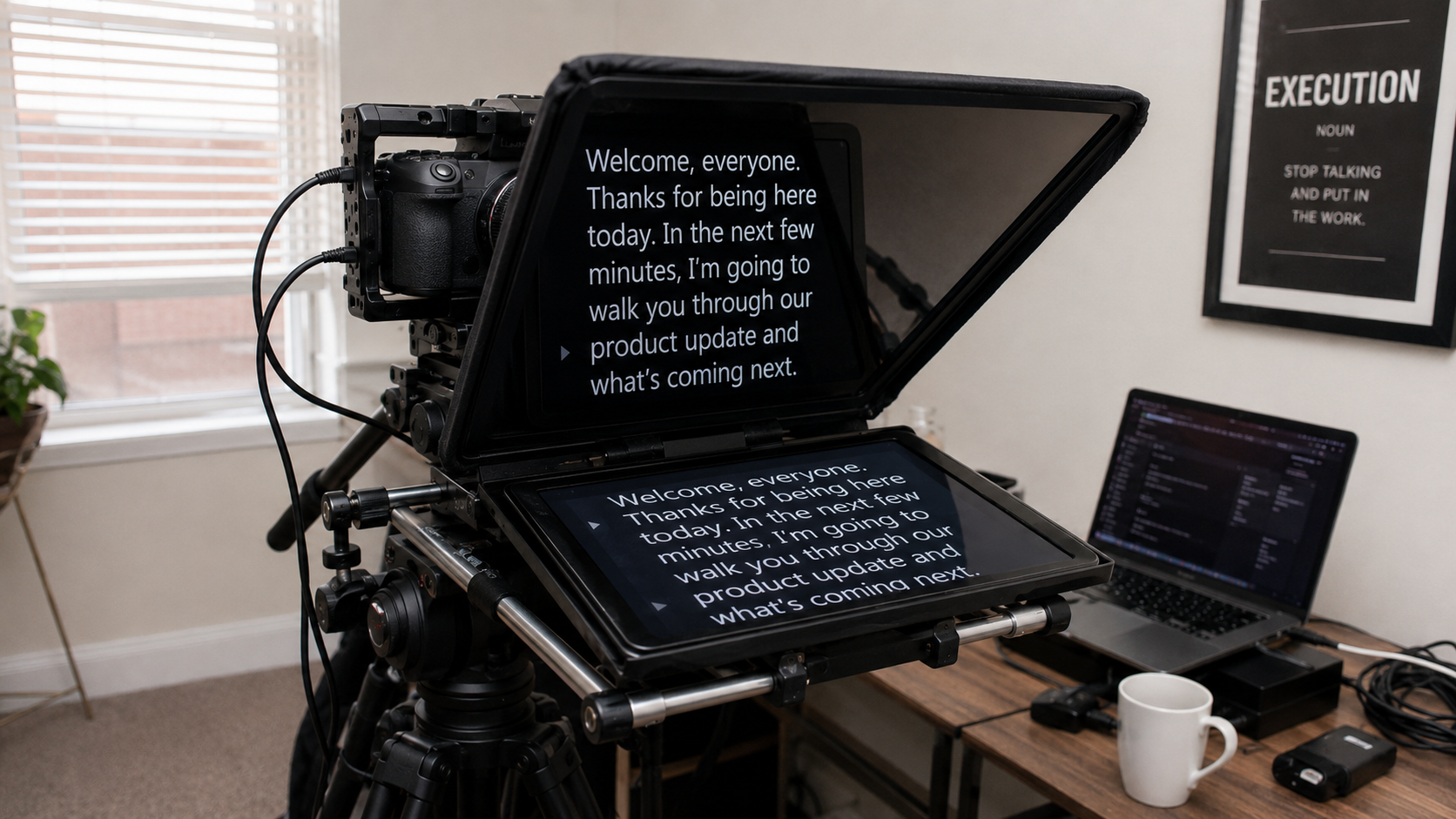
A teleprompter isn't a "cheat device." It's an external brain.
Just as you wouldn't call using a calculator "cheating at math," you shouldn't call using a teleprompter "cheating at speaking." A calculator frees you from repetitive computation so you can focus on problem-solving strategy. A teleprompter frees you from memorization so you can focus on the act of expression itself.
This tool exists not to turn you into "someone who reads scripts." It exists so every good sentence you write, every sharp insight you prepare, and every well-crafted story you polish — all of it reaches your audience exactly as you intended.
Try the free online teleprompter first
If you are solving script, pacing, line-memory, or filming workflow issues, open the browser teleprompter first and test the script there. Use the CueBuddy app when you need a stronger mobile recording workflow.
Start your next recording with CueBuddy
Try the free teleprompter workflow first, then open CueBuddy if you need stronger recording and camera workflows.